
Today we watched a 2009 BBC documentary called ‘seven photographs that changed fashion,’ by fashion photographer Rankin. In this documentary Rankin took us through the history of fashion with seven artist he felt changed the fashion industry. He recreated photographs from artists including, Cecil Beaton, Erwin Blumenfeld, Richard Avedon, David Bailey, Helmut Newton, Guy Bourdin, and Herb Ritts.
The first fashion image that Rankin recreated was Cecil Beaton’s Hat Box, which was taken in 1934. The origional photograph featured model Elsa Schiaparelli, Rankin’s recreation features artist/Model Sophie Ellis-Bexter.
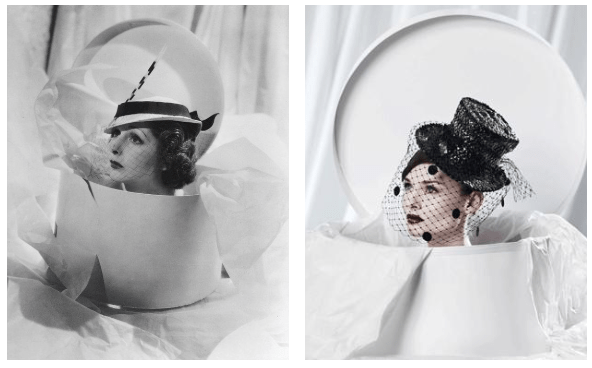
Flamboyant photographer Cecil Beaton created many Vogue covers throughout his career, specifically in the ‘swinging sixties’, with a 1932 Rolleiflex camera. In the documentary, Rankin first attempted to recreate this image using the camera that Beaton would’ve used. As the process was lengthy and difficult, Rankin returned to his usual digital camera. I personally feel that this image works well with using a digital camera as it shows the models features extremely well and I like that it is in colour, but I much prefer the original. Beaton’s original image demonstrates much more emotion.
The next recreation was of a 1950’s Vogue front cover by Erwin Blumenfeld.
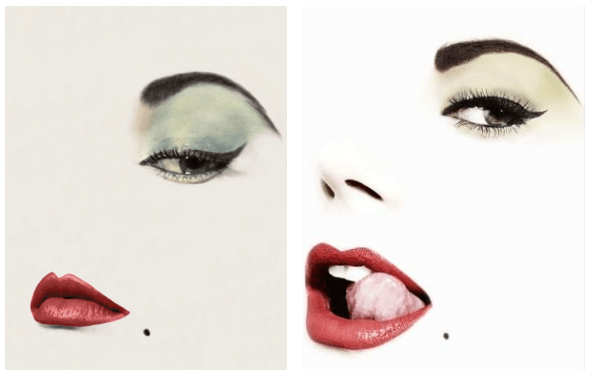
Blumenfeld’s photography was heavily influenced by surrealism, many of his portraits are distorted from variations of lighting concepts. This Vogue cover from 1950 demonstrates Blumenfeld’s surreal imagery, and is still one of the most influential magazine covers of all time. The 1950 Vogue cover was originally taken in black and white but was bleached by Blumenfeld and then coloured by hand. In the documentary Rankin says to the audience that you ‘do not question where the rest of the face is’ and I completely agree. Rankin shot his version of this image with Heidi Klum. I like how Rankin has modernised the image with Heidi letting her cheeky personality come through with her tongue showing.
Rankin next created his own version of Richard Avedon’s 1955 image ‘Dovima with Elephants.’

These two mirroring images show nature incorporated into the fashion industry. The original image created in 1955 by Avedon had elephants tied down with chains, whereas, the elephants in 2009 seem to be free. It also looks as if Dovima is naturally soothing them, in the original image, were as in the recreated version the model, Erin O’Conner, looks less comfortable and statue like. Comparing the two images I love how Rankin’s picture is bold, however, I prefer the original image because it looks like Dovima was just caught in a moment and not actually modelling.
Next in the documentary, Rankin recreated David Bailey’s 1960 image of Jean Shrimpton, on of Bailey’s previous lovers.
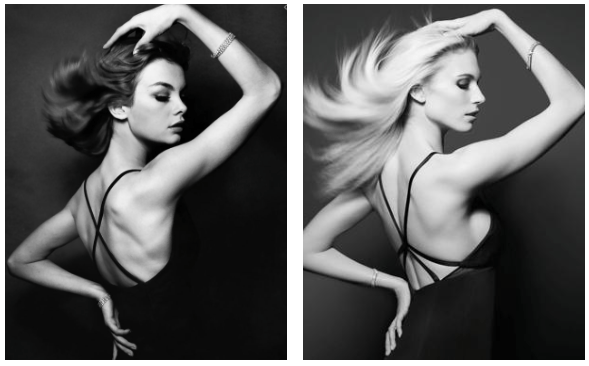
David Bailey always brought great energy, life and charm to his photos. In this original photograph for Vogue, Bailey only used a large piece of cardboard to create the wind demonstrated in her ‘hair flick.’ Rankin re-created this image with his model girlfriend, Tuuli, and used the same techniques to create the hair drop. Both images are similar and leave the emphasis on the models figure, pose and beauty. However, in Baileys original you can almost see the other side of Jeans face as if the lighting is bouncing off her skin and features making the photo look more sharp and rounded were as in Rankin’s, Tuuli could almost pass as a painting.
Helmut Newton’s 1975 Rue Aubriot was the next iconic fashion image that Rankin chose to recreate.
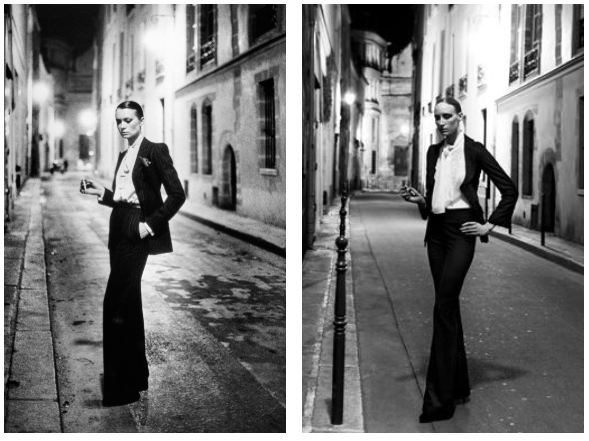
Helmut Newton’s work often includes women in their underwear, or sometimes in the nude, his style empowered women rather than objectifying them. This image, ‘Rue Aubriot’ presented in Vogue, shows off this woman’s height and presents slight masculinity, this could be suggesting the equality between men and women. I like how Rankin has taken this photograph on the exact same street as Newton and has made it clear as to which one is modern and which one is not. In the original picture the street looks quite gloomy and mysterious. In Rankin’s recreated image I can tell it is a model posing for a photograph, it doesn’t look as natural as the original. I believe that this is the best recreation image from the documentary, it is the most exact.
Rankin then recreated a fashion image from the 70’s by Guy Bourdin.
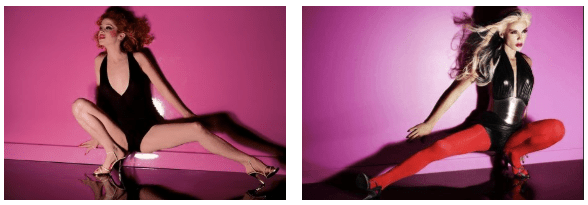
Guy Bourdin developed the stylising of sex through the seventies in a sophisticated way. His commercial images were adventurous, colourful and sexual but always had a feel of art within them. Bourdin uses soft-boxes or spotlights directly on the model to light up the their complexion, outfit and expression. Rankin used the same technique with lighting, however, he made the hair and makeup more dramatic whilst covering the models legs with bright tights. Both images are very similar in regards to the models pose but I feel that Rankin increased the colour palette and saturation too much.
The final image that Rankin recreated was Herb Ritt’s 1984 ‘Fred with tyres.’
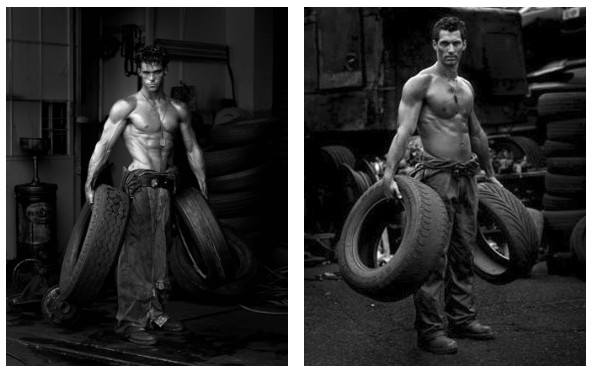
Herb Ritt’s original image transformed how men were viewd in the fashion industry. Following the trend through the 70’s of empowering the sexuality of women, this was then followed by the men of the 80’s. Comparing both images it seems as though Rankin’s photo looks more natural as if he caught Model David Gandy actually at work, rather than him posing. When Rankin recreated his version of the image the contrast was created in post production to reflect Ritt’s photographic style.
Watching this documentary was really influential to me for my final major project. I am wanting to create images which explore the world of fashion through the decades. I will be researching the equipment and lighting set up that would’ve been used in each decade. This documentary has helped me to understand exactly how the world of fashion has evolved and I am now looking forward to creating my own work.
 Final Major Project